 CalmBeach Greece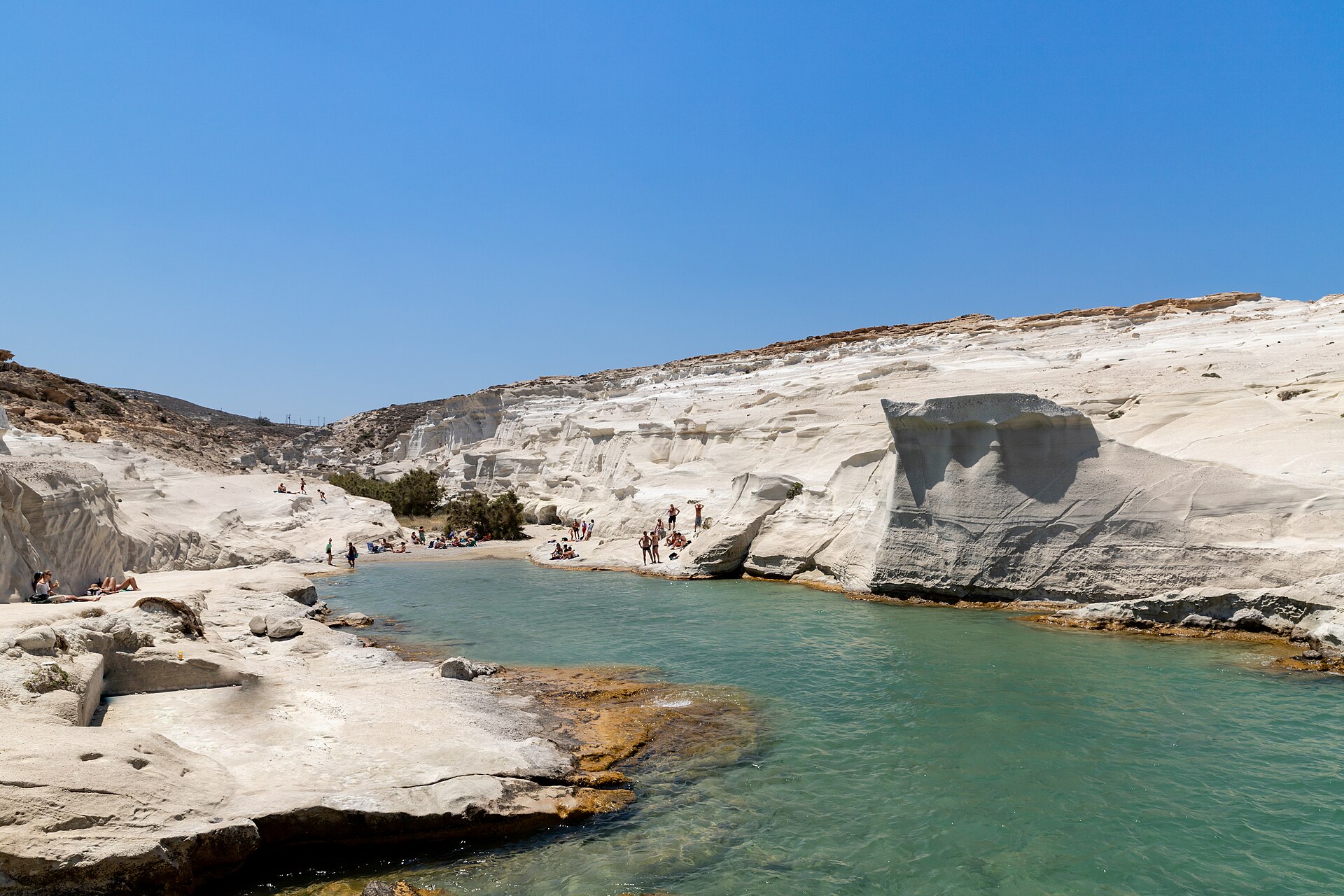
Sandy
Sandy beaches in Milos
13 sandy beaches in Milos: with sand underfoot rather than pebbles. Check live wind & waves for each beach on CalmBeach before you go.
- 13beaches
- 9organized
- 5with photos
Looking for sand rather than pebbles in Milos? These 13 beaches are recorded as sandy, so they are easier on bare feet and better for children playing. Check wind and waves in CalmBeach before you go.
The beaches
-
Tsigkrado
The hidden cove with ropes — Tsigrado is a small, hidden sandy cove on the south coast, just past Firiplaka, with water that ranges from emerald to deep blue inside white-grey…
-
 Palaiochori
The beach with hot sand — Paleochori sits right on top of the living volcanic system of Milos. Underwater hot springs and fumaroles warm the sand and the shallows: dig a small…
-
 Fyropotamos
The fishing hamlet with boat houses — Firopotamos is a tiny fishing hamlet on the north coast, with only a handful of permanent residents. Its hallmark is the "syrmata": single-room boat…
-
Provatas
The amphitheatre bay with red rocks — Provatas is an organised sandy beach on the south coast, set in an amphitheatre-shaped bay framed by reddish rocks that give the sand a golden-red…
-
 Plathiena
A little offshore stands the volcanic rock formation "Arkoudes" ("the bears"), whose bear-like shape is best seen from the sea.
-
Agia Kyriaki
The volcanic shore with the chapel — Agia Kyriaki lies on the south coast, next to Paleochori, with golden sand giving way to small white pebbles and turquoise water. It is named after…
-
 Pollonia
The northern fishing village — Pollonia (or Apollonia) is the island's second settlement and second port after Adamas — a fishing village on the north-east coast that grew into a…
-
Achivadolimni
The longest beach and its wetland — Its name means "clam lake". The lake behind it is the largest natural wetland in the Cyclades…
-
Fyriplaka
The multicoloured volcanic cliffs — Firiplaka stretches along the south coast, with fine greyish sand and white pebbles beneath tall cliffs. What sets it apart is the colour of the…
-
.jpg&width=400)
-
Sarakiniko
The lunar landscape of Milos — Sarakiniko is the most recognisable landscape on Milos: pale, off-white volcanic rock — compacted ash and pumice — that wind and waves have sculpted…
Photo credits
- Palaiochori: rene boulay, CC BY-SA 3.0
- Fyropotamos: rene boulay, CC BY-SA 3.0
- Plathiena: Manfred Werner (Tsui), CC BY-SA 4.0
- Pollonia: Zde, CC BY-SA 4.0
- Agios Sostis: Johnk996, CC BY 3.0
Good to know
Which beaches in Milos are sandy?
The beaches listed here are recorded as sand rather than pebbles or rock. Shorelines shift with storms and seasons, so the mix can change from year to year.
Does sand mean shallow water?
Not always. Sand describes the shore, not the depth — some sandy beaches drop away quickly. Open a beach to see its recorded depth, and check live wind and waves before you swim.
When is the sea calmest here?
Across 13 of the beaches on this page, the open water in front of them is typically 0.72 m in June, 0.72 m in July and 0.73 m in August when the meltemi is at its strongest, and 0.76 m in September. June is the calmest month of the season. We calculate these figures ourselves from European Copernicus wave-model data at 4.2 km resolution. They describe the sea offshore, not the shelter of an individual cove — a bay protected by a headland will usually be calmer than this.
How warm is the water, month by month?
Off 13 of the beaches on this page the sea is typically 19.0 °C in May, 22.6 °C in June, 24.5 °C in July, 25.2 °C in August and 24.4 °C in September — ideal at the height of summer, mild in June. By October it is 22.4 °C. August is the warmest month. Satellite measurements, 1995–2024, from a sea cell about 5 km offshore; shallow bays usually run warmer than this.
Wind and waves change every day. See live conditions for any of these beaches before you drive out.
Open the live map →